Deleuze and Cinema, a New Metaphysics of the Arts
A new project from Letters from the 20th Century
Dear Reader,
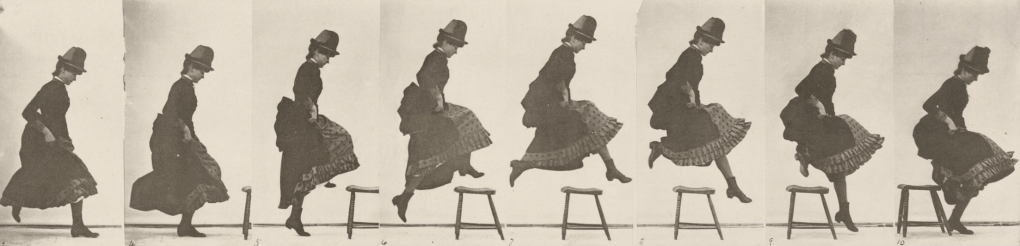
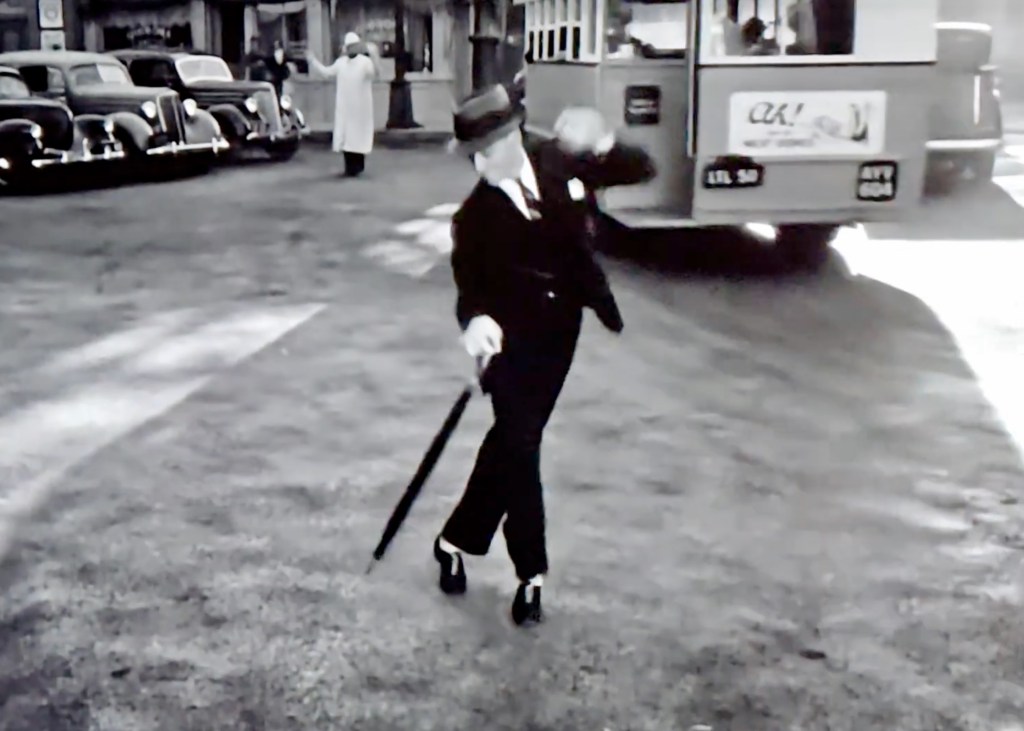
At the beginning of the twentieth century, a new world emerges, one in which art and philosophy leave behind the unchanging, the eternal, epitomised by the long-exposure photograph; the focus is now on what the French call the instantané, the “snapshot.” We see the beginnings of the emergence of the new, in Eadweard Muybridge’s equidistant snapshots of a woman jumping over a stool. We see the new as it comes to fruition, in the film of Fred Astaire’s “action dance” in a traffic-filled street. Each protagonist is made to respond to the peculiarities of the space in which they find themselves, in doing so they produce the new. But, are artists and philosophers up to the task of thinking the new? The problem that this question asks about, is the problem of the metaphysics appropriate to the new, and the role that cinema and cinema directors play in its formation.
Between 1983 and 1985, Gilles Deleuze published a two-book study of cinema: Cinema 1: The Movement-Image, and Cinema 2: The Time-Image. The overall aim of this work is to create an account of how artists think, as such, the study constitutes a new metaphysics of the arts, one that combines the philosophical thinking of Henri Bergson (1859-1941), and the semiotic analysis of Charles Sanders Peirce (1839-1914).
Deleuze says the “great film directors” are artists who think with movement-images and with time-images; therefore, cinema is “part of art and part of thought.” This two-part structure is reflected in both of Deleuze’s books, which interlace a theoretical analysis of Bergson’s and Peirce’s thinking, with examples drawn from the works and the thoughts of chosen film directors. In talking about their work, Deleuze says directors “become philosophers;” therefore, “there is always a time, midday-midnight, when we must no longer ask ourselves, ‘What is cinema?’ but ‘What is philosophy?’” Rather than separating, Deleuze’s study of cinema brings art and philosophy, “midday-midnight,” together.
Time and movement are physical realities in the external world, whereas images are mental realities in consciousness; therefore, both time and movement are traditionally opposed to images. Bergson’s 1896 book, Matter and Memory changes all this, with his discovery of movement-images and time-images, dualities that combine rather than separate their terms. The technical and the poetic history of cinema shows that cinema is involved in instigating the changes in sensibility that Matter and Memory anticipates. Cinema moves from its beginning as “the perfected apparatus of the oldest illusion,” to its later role as “the organ for perfecting the new reality.” As such, cinema is uniquely well placed to provide what Deleuze thinks art lacks, a metaphysics that matches the metaphysics that Bergson’s thinking provides for science.
Philosophy encourages us to think beyond entities, towards being. Alongside the being of entities–beings, there is also that which overwhelms us, takes us by surprise, the study of which Aristotle calls theologike, “theology.” Heidegger says that, for Aristotle, philosophy has a twofold character: “knowledge of being and knowledge of the overwhelming.” It is this twofold character that is encompassed in the single name: “metaphysics,” from meta ta physika, the thinking that thinks “beyond beings.”
The metaphysics of cinema that Deleuze aims for, is in the form of a taxonomy, a classification of “images and signs.” The notion of images is derived from Bergson, while Deleuze’s understanding of signs is derived from Peirce. It is Peirce who first classifies images, then moves from images to signs and then to a classification of signs. Deleuze says that Peirce:
“…established a general classification of images and signs, which is undoubtedly the most complete and the most varied. It can be compared with Linnaeus’s classifications in natural history, or even more with Mendeleev’s table in chemistry.”
Peirce’s classification is triadic, according to numbers 1, 2, 3. It is numbers that first bring Bergson and Peirce together. Cinema 1 begins with the first of four commentaries on Bergson, which details what Deleuze calls Bergson’s “Theses on Movement.” There are three such theses, which Deleuze classifies in terms of images: 1. Instantaneous images; 2. Movement images; 3. Time images.
“Midday-Midnight” is hosted by Letters from the 20th Century on Substack. The aim of my project, is to follow Deleuze, as he develops his metaphysical taxonomy of cinema, and by extension art, across both cinema books. I will realise this aim in two ways:
- First, through a close, analytical reading of each of the cinema books, beginning with Cinema 1. These weekly readings and the text being read, will be live-streamed on Substack, and will be open to all subscribers. Recordings of each live-stream will be available to paid subscribers.
- Second, I will, at intervals, present exhibitions of my work, as an artist. My intention is that these exhibitions will serve as the ground for a thinking that will extend Deleuze’s metaphysics of the arts into visual art, particularly painting and drawing. These exhibitions will be accessible on this website, and on Substack.
The first live reading reading, chapter 1 of Cinema 1: “Theses on Movement: First Commentary on Bergson,” will take place Monday, September 14 at 1800 BST on Substack. I envisage that each reading will last about two hours. This is the link to the live reading: https://open.substack.com/live-stream/351583?utm_source=live-stream-scheduled-upsell . I hope you will be able to join me on this journey, until then…
Thank you for reading.
Derek Hampson
P.S. The books by Gilles Deleuze that I will be referencing are:
Cinema 1: The Movement-Image, University of Minnesota Press, 1997.
Cinema 2: The Time-Image, University of Minnesota Press, 1997.

